NHADACA Legislative Policy Tracker

This tracker is designed to provide updates on policies that may impact our constituents, while also offering education and raising awareness about current legislative bills.

  • Support

    SB 620- relative to refusal of consent to testing to determine alcohol concentration and penalties for aggravated driving while intoxicated. 

    SB 620 Description


    Position: Support


    Justification: This bill supports public safety by strengthening accountability measures for individuals who refuse alcohol testing and for those convicted of aggravated driving while intoxicated. By increasing penalties and requiring substance use disorder evaluations, it emphasizes both deterrence and the importance of identifying and addressing underlying substance use issues. 


    SB 624- restricting access to certain hemp-derived products. 

    SB 624 Description


    Position: Support / Monitor  


    Justification: By setting THC limits, defining product standards, and implementing age restrictions, it aims to reduce potential risks associated with unregulated or high-potency products.  


    SB 557- making synthetic and semisynthetic kratom illegal to prepare, distribute, manufacture, sell, possess, or advertise, with exceptions made for scientific research. 

    SB 557 Description


    Position: Support 


    Justification: These measures help protect young people and ensure consumers have access to safe, properly labeled products. The proposed amendment further strengthens the bill by improving oversight, product standards, and enforcement.  


    HB 1630- prohibiting the sale of nitrous oxide and certain inhalants for recreational purposes. 

    HB 1630 Description


    Position: Support 


    Justification: By prohibiting unlawful sales while allowing for legitimate medical, industrial, and commercial uses, it strikes a balance between prevention and appropriate access. The inclusion of age restrictions and clear penalties helps reduce youth access and discourage harmful behaviors. 


    HB 1790 - relative to involuntary admissions for certain individuals with a substance use disorder. 

    HB 1790 Description


    Position: Support / Monitor  


    Justification: This bill represents an effort to address the serious risks associated with substance use disorder by expanding the criteria for involuntary admission when individuals pose a danger to themselves or others. By recognizing substance use disorder within the broader framework of mental illness, it may help ensure that individuals in acute crisis can access necessary care and stabilization. 


    HB 1538 - preventing vape products from being marketed towards minors 

    HB 1538 Description


    Position: Support  


    Justification: This bill helps protect youth by explicitly prohibiting the marketing of vape products in ways that appeal to minors, such as using candy-like packaging, school-themed designs, or popular media characters. By targeting these marketing tactics, it reduces the likelihood that young people will be enticed to experiment with vaping, which is linked to long-term health risks. The inclusion of provisions against interactive features like video game capabilities further limits the appeal of these products to a younger audience.


    SB 461- relative to the definition of hemp. 

    SB 461 Description


    Position: Support  


    Justification: This bill provides a clear and comprehensive definition of hemp by including all parts of the Cannabis sativa L. plant, its seeds, derivatives, and extracts, ensuring consistency across legal and regulatory frameworks. By introducing total THC concentration, including tetrahydrocannabinolic acid (THCA), it captures the full spectrum of compounds relevant to compliance and consumer safety. Overall, the bill strengthens clarity in the hemp industry while maintaining alignment with federal thresholds and industry best practices. 


    HB 1328- relative to alcohol and other drug use professionals and relative to the qualifications to obtain certain occupational licenses. 

    HB 1328 Description


    Position: Support with Amendments  


    Justification: The structure of the board aligns with current trends in credentialing and workforce development, helping ensure standards remain relevant and responsive to community needs.  


    SB 470 - relative to the expungement of certain disciplinary matters. 

    SB 470 Description


    Position: Support  


    Justification: This bill promotes fairness and professional rehabilitation by allowing qualified licensees to petition for the expungement of certain disciplinary records, recognizing that past mistakes do not always reflect current competency. By establishing clear criteria—such as a clean disciplinary history and good standing—it balances the opportunity for rehabilitation with public safety. Granting expungement for minor actions like reprimands or fines helps remove unnecessary barriers to career advancement while maintaining accountability. 


    SB 465- classifying xylazine as a schedule III controlled drug. 

    SB 465 Description


    Position: Support  


    Justification: This bill enhances public safety by formally classifying xylazine as a Schedule III controlled substance, ensuring stricter oversight and regulatory control over its distribution and use.  


    SB 298- relative to sober living house certification and operational standards. 

    SB 298 Description


    Position: Support  


    Justification: By setting clear operational criteria, requiring resident rights postings, and providing formal complaint procedures, it ensures safer and more supportive environments for individuals in recovery. The certification process also promotes consistency and professionalism across recovery residences, helping residents and families make informed choices. 

  • Oppose

    SB 441 - requiring a municipality that intends to transport a person needing substance use disorder treatment and other support services to have a memorandum of understanding with the receiving municipality prior to transport. 

    SB 441 Description


    Position: Oppose


    Justification: This bill creates barriers to timely access to substance use disorder treatment by requiring municipalities to establish memorandums of understanding before transporting individuals in need of care. 


    HB 1052 - relative to qualifications for licensure as a LADC, or licensed alcohol and drug counselor. 

    HB 1052 Description


    Position: Oppose


    Justification: This bill may create unintended loopholes in the licensure process by allowing individuals to qualify for LADC licensure without meeting existing higher education standards. Expanding eligibility to include the internationally certified alcohol and drug counselor credential without a degree requirement could diminish the consistency and rigor of New Hampshire’s licensing framework. Additionally, differences in requirements across states participating in the IC&RC may allow entry into the field without comparable educational preparation. This could negatively impact insurance reimbursement rates and reduce available resources for treatment services, ultimately affecting the quality and sustainability of care.


    HB 529 - relative to the liquor commission 

    HB 529 Description


    Position: Oppose  


    Justification: This bill may increase the risk of alcohol misuse by expanding home delivery access, potentially reducing oversight of who is receiving alcoholic beverages. Allowing restaurant deliveries could make it more difficult to enforce responsible service practices and age verification, particularly in private settings. Additionally, this expansion may create challenges for public safety and enforcement without clear evidence that it provides significant public or economic benefit. 


    CACR19 - relative to the personal possession of cannabis. Providing that adults 21 years of age or older shall have the right to possess a modest amount of cannabis intended for their personal consumption. 

    CACR19 Description


    Position: Oppose 


    Justification: This proposed constitutional amendment may limit the state’s ability to adapt cannabis policies over time by embedding possession rights into the constitution rather than statute. It could reduce flexibility for policymakers to respond to evolving public health, safety, and regulatory considerations. Additionally, expanding access without a comprehensive regulatory framework in place may raise concerns about oversight and potential unintended impacts. 


    SB 452- enabling health care providers to offer certain complementary and alternative health care services. 

    SB 452 Description


    Position: Oppose 


    Justification: This bill could pose significant risks to public health by allowing individuals to provide complementary and alternative health care services without state licensure or oversight. Without proper regulation, there is a higher likelihood of unqualified practitioners delivering treatments that may be ineffective or potentially harmful. The lack of licensing requirements also reduces accountability and consumer protections, making it difficult to enforce safety standards or respond to complaints. 

  • Monitoring

    SB 624- restricting access to certain hemp-derived products. 

    SB 624 Description


    Position: Support / Monitor  


    Justification: By setting THC limits, defining product standards, and implementing age restrictions, it aims to reduce potential risks associated with unregulated or high-potency products.  


    HB 751- establishing a committee to study licensure of outpatient substance use disorder treatment facilities, authorizing parents to enroll their children in any public school in the state and creating a limited exemption from parental consent required for certain recordings under the parental bill of rights. 

    HB 751 Description


    Position: Monitor  


    Justification: Monitoring this aspect is important to understand how potential new licensing or oversight requirements could impact access to care, service quality, and the operational capacity of providers. The committee’s findings may shape future policy decisions that affect the balance between regulation and accessibility within the recovery support system. We are monitoring rather than supporting due to the inclusion of other items in this bill.


    HB 1790 - relative to involuntary admissions for certain individuals with a substance use disorder. 

    HB 1790 Description


    Position: Support / Monitor  


    Justification: This bill represents an effort to address the serious risks associated with substance use disorder by expanding the criteria for involuntary admission when individuals pose a danger to themselves or others. By recognizing substance use disorder within the broader framework of mental illness, it may help ensure that individuals in acute crisis can access necessary care and stabilization. 


    HB 186- relative to the legalization and regulation of cannabis and making appropriations therefor. 

    HB 186 Description


    Position: Neutral / Monitor  


    Justification: This bill proposes a comprehensive framework for the legalization, regulation, and taxation of cannabis for adults aged 21 and older, while maintaining key public safety protections such as prohibiting sales to minors and driving under the influence. By establishing licensing standards, product testing, and labeling requirements, it aims to ensure consumer safety and consistency in the marketplace. 


    HB 1235 – Legalizing Certain quantities of cannabis  

    HB 1235 Description


    Position: Monitor  


    Justification: This bill could significantly change the legal landscape around cannabis in New Hampshire by permitting adult possession and use within defined limits while maintaining penalties for underage use. It may reduce arrests and criminal justice involvement for low-level possession, while shifting enforcement toward regulation and public health considerations. The bill could also impact workplaces, law enforcement practices, and the court system, with potential cost implications related to changes in penalties and case processing. 


    SB 640 - relative to the use of artificial intelligence to provide services requiring a professional license. 

    SB 640 Description


    Position: Monitor  


    Justification: By requiring licensed professionals to maintain oversight, review AI-generated outputs, and obtain client consent, it emphasizes accountability and client safety. The legislation also clarifies appropriate AI applications, limiting its use to administrative or supportive tasks while excluding certain non-licensed services. 


    SB 549 - requiring certain syringe service program entities to provide options for disposal of used syringes and needles and creating reporting requirements for such entities 

    SB 549 Description


    Position: Neutral  


    Justification: It reflects an effort to balance concerns about the use of public funds with the need to address health and safety issues associated with substance use. At the same time, it may raise questions about how communities can continue to effectively prevent the spread of infectious diseases without consistent support for syringe service programs. 


    SB 450- relative to a state parks pass pilot program for recovery centers and community mental health centers.  

    SB 450 Description


    Position: Neutral / Monitor  


    Justification: This bill establishes a pilot program to provide state park passes to community mental health centers, potentially increasing access to outdoor recreational opportunities for individuals in recovery and those receiving mental health services. By creating a structured, time-limited pilot, it allows for evaluation of the program’s impact and feasibility before broader implementation. 

NHADACA Announcements
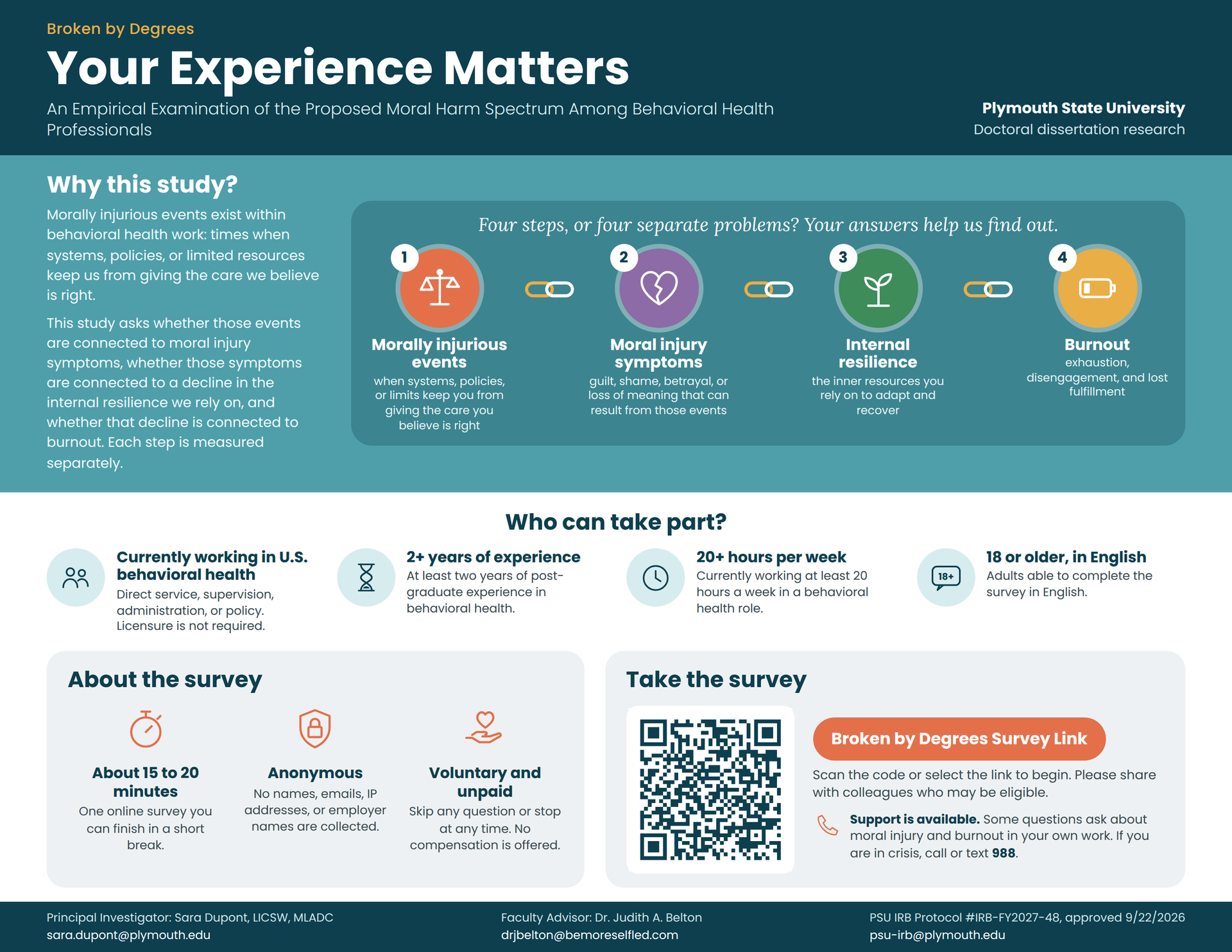
By Destiny Heery September 9, 2025
New Hampshire CRSW Test Preparation Group Trainer

By Dianne Castrucci September 3, 2025
New Hampshire CRSW Supervisor
By Destiny Heery May 28, 2025
Governor Kelly Ayotte has signed House Bill 507 into law, a major step forward in improving access to mental health care across the state. Starting January 1, 2026, health insurers will be required to process credentialing applications from mental health professionals within 30 days—matching the timeline already in place for primary care providers. This legislation, championed by the New Hampshire Insurance Department (NHID) and supported by healthcare leaders and mental health advocates, removes a key administrative barrier that has delayed care for many Granite Staters. “This law brings mental health help closer to home for more people, faster,” said Insurance Commissioner DJ Bettencourt. “It strengthens our workforce and ensures qualified providers can get to work without unnecessary delays.” The NHID will continue working with insurers and providers to ensure a smooth rollout of the new requirements. Learn more at insurance.nh.gov .
By Destiny Heery April 2, 2025
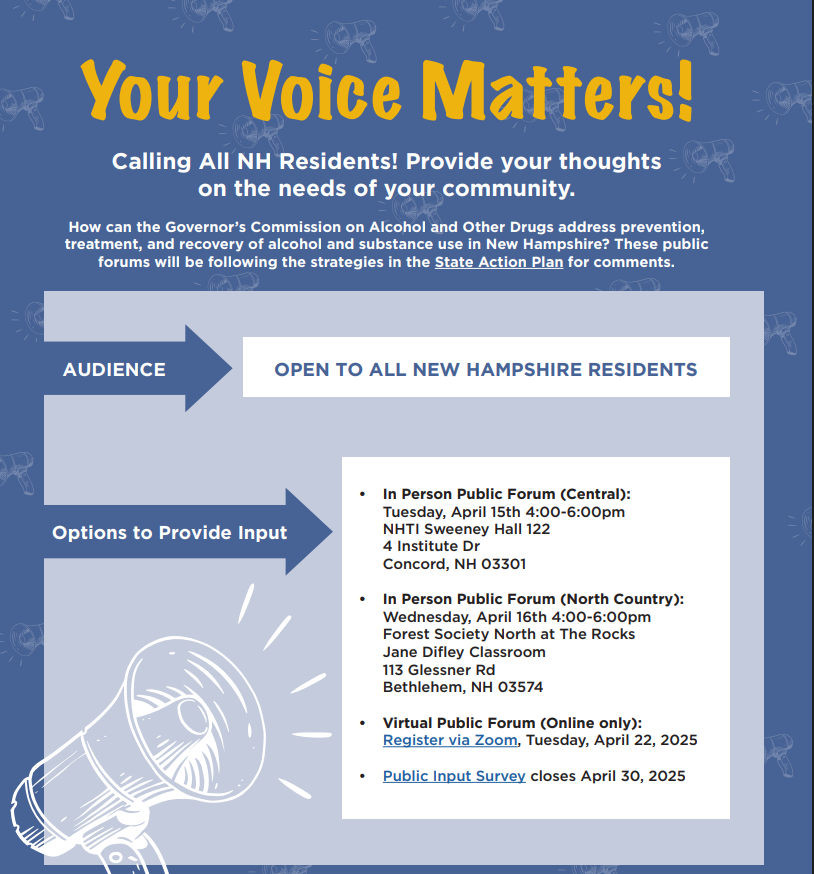
The Governor’s Commission on Alcohol and Other Drugs is seeking to gather information from professionals, those with lived experience around substance use, and all New Hampshire residents to inform strategic decisions around Alcohol Fund investments. There will be four opportunities for participation: Attend the in-person public forum on Tuesday, April 15th at NHTI – Sweeney Auditorium 122 (31 College Drive, Concord, NH 03301) from 4:00-6:00 pm. Attend the in-person public forum on Wednesday, April 16th at The Rocks – Jane Difley Classroom (113 Glessner Rd, Bethlehem, NH 03574) from 4:00-6:00 pm. Attend the online public forum on April 22nd via Z oom from 4:00-6:00 pm. Provide your thoughts on your own time via this sho rt survey . For more information, visit https://nhcenterforexcellence.org/governors-commission/ .

By Destiny Heery December 19, 2024
Register for upcoming sessions below! There is no fee to register or attend any of these training sessions as this CSP series has been made available through funding by Substance Abuse and Mental Health Services Administration (SAMHSA).
By Destiny Heery December 17, 2024
NHADACA's Clinician Wellbeing Network offers monthly groups, topics include: Grief and Loss - 2nd Wednesday from 8:00am-9:00am; virtual; for clinicians experiencing grief and loss.  Wellness - 1st Wednesday from 8:00am-9:00am; virtual; for all clinicians. Open Discussion - 3rd Thursday from 9:30am-11:30am; virtual; for all clinicians. Independent Practice - 3rd Wednesday from 8:00am -9:00am; virtual; for those in or intending to be in a private practice. Clinical Supervisors - 4th Thursday 12:00pm-1:00pm; virtual; for MLADCs providing clinical supervision Vicarious Trauma - TBA

By Destiny Heery December 11, 2024
We’re thrilled to welcome two exceptional new members to our Board of Directors! Please join us in welcoming Robert Meshna and Ivysue Hranac. Their expertise and commitment to our mission will be invaluable as we continue to expand our impact and strengthen our community. Robert Meshna, LADC, CRSW, NCPRSS - The Doorway of Greater Nashua. Biography: I have worked in the substance use/behavioral health field for 13 years. I started my career in Florida working in inpatient substance use treatment facilities. I moved to New Hampshire where I met my wife and now have a two-year-old son. I continued to work in a local inpatient treatment facility and eventually found my way to the Doorway of Greater Nashua in 2020. I obtained my NCPRSS with NAADAC in 2018. I have been a licensed CRSW since 2019 and became a CRSW supervisor in 2022. I recently obtained my LADC in May 2024. I graduated from SNHU summa cum laude with a bachelor’s in human services with a concentration in substance use. I am currently enrolled in a Master of Social Work program at UNH. I have worked at the Doorway of Greater Nashua for over 4 years helping people access treatment and providing recovery support services. I enjoy advocacy work, helping people into and maintain recovery, and helping with professional and personal growth. I enjoy spending time with family, traveling, doing yard work and DIY projects. Statement of interest: I would love the opportunity to join the board to help other students through any questions about licensing career guidance, professional development. Sharing personal experiences and experiences of others can normalize and positively reinforce people’s goals and aspirations during what can be anxiety provoking times. I experienced limited career guidance with many schools when deciding which school to attend and there were many limitations that advisors faced when guiding students. Many of these experiences have also been shared by my peers and colleagues over the years. I also experienced challenges in the licensing process and wish I had someone to help me through them. Ivysue Hranac, LICSW - Rockingham County Department of Corrections Biography: Ivysue currently works at Rockingham County Department of Corrections as the Mental Health Supervisor. She has worked with individuals who have mental health issues as well as cooccurring issues. She has been a case manager, intern, clinician and supervisor/program director prior to her current role. In her former role she was the program director for a program which placed individuals who were incarcerated for dangerous crimes and had a mental health issue into the community for re-integration. Currently she is working on obtaining her MLADC credentials. She has a Bachelor's degree in Criminal Justice and a MSW from the University of Wyoming and is a Licensed Independent Clinical Social Worker in New Hampshire and Washington state. She has worked in the mental health field for 14 years and believes in bringing a humanistic approach to her work. She has provided training in Motivational Interviewing and continues to use this experience as she works with individuals who are incarcerated. She is raising two of her grandchildren with her partner and recently moved back to New Hampshire from Washington. Statement of interest: I would like to serve on the NHADACA board because I am excited to be in community with other individuals who believe in the mission of NHADACA. I look forward to discussions with people who have more knowledge than I do about the SUD system and how we can support all SUD clinicians to better the outcomes of the humans we work with. I have personal as well as professional insight into some of these issues and would hope to be helpful in shaping our state to be a leader in the SUD and Co-occurring milieu.

By Destiny Heery December 11, 2024
The Contract Lifecycle is a series of finance trainings designed for those who contract with the NH Department of Health and Human Services (DHHS). Register for upcoming sessions below! There is no fee to register or attend any of these finance training sessions as this finance training series has been made available through funding by the Bureau of Drug & Alcohol Services in collaboration with the NH Charitable Foundation. 
By Destiny Heery August 28, 2024
By Destiny Heery August 12, 2024
On August 8, 2024, the LADC Board adapted the revised Alc 400 rules, which will take effect in 60 days. The public has 30 days to email the LADC Board with any questions or concerns pertaining to the new rules. Additionally, The LADC Board also advised that they are re-opening the Alc 300s again. Follow the process below, per the Office of Professional Licensure and Certification (OPLC), to submit a request: Plc 209.01 Requests for Explanation of Adopted Rules . (a) Any interested person may, within 30 days of the final adoption of a rule, request a written explanation of that rule by making a written request to the executive director, for any rule in title Plc, or to the board that adopted the rule, for rules in any title other than Plc. (b) A request submitted pursuant to (a), above, shall include: (1) The name and address of the person making the request and, if the requestor is an entity, the name, address, and email address of the individual authorized by the entity to make the request; and (2) Identification of the specific rule for which an explanation is sought. Click here to review the revised changes.
By Corissa Webb June 28, 2024
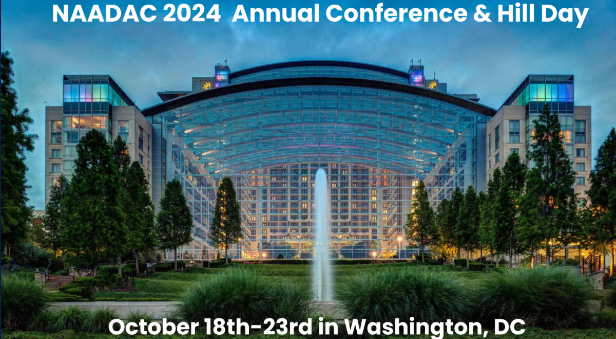
Join more than 1,500 addiction professionals in Washington, DC for the NAADAC 2024 Annual Conference & Hill Day from October 18 to 23, 2024! Engage in learning, networking, advocacy, and success. NAADAC's 2024 Conference offers a comprehensive six-day educational event focused on addiction, featuring intensive training sessions by renowned experts, a day dedicated to advocacy on Capitol Hill, poster presentations, an expansive exhibit hall, special events, ample networking opportunities, and many additional activities!  The NHADACA Board of Directors awards 2 of our members with a scholarship to attend this event annually. As a NHADACA member, you can submit a scholarship application by July 22, 2024. Scholarship Application You can read more about this event here: https://www.naadac.org/annualconference

By Corissa Webb May 3, 2024
The University of Rhode Island offers access to six free continuing education modules for healthcare professionals on substance use disorders (SUD), requesting bulk naloxone for distribution to your community, and/or requesting a free "live" overdose response training seminar for your group or organization. Seminars are offered via Zoom and are geared towards the general public or can be accredited for 1 hour of live CEU for healthcare professionals (live CEU available for pharmacists, nurses, social workers, or licensed mental health counselors). Learn more here: https://web.uri.edu/rota-r/
By Corissa Webb May 3, 2024
A new report, released by SAMHSA, explores the financing, utilization, and regulatory structures of providing peer recovery support services (PRSS) for substance use disorder (SUD) recovery process within federal grant programs and state Medicaid programs. This report identifies challenges and opportunities to finance and strengthen the PRSS workforce. It also provides a description of the variation in peer recovery rates, supervision, credentialing, and substance use disorder vs mental health. You can find it here: https://www.samhsa.gov/cfriutm_source=SAMHSA&utm_campaign=935ab5c617EMAIL_CAMPAIGN_2024_04_08_05_20&utm_medium=email&utm_term=0_-935ab5c617-[LIST_EMAIL_ID] In addition, SAMHSA also released a webinar covering the same topic. You can access the webinar here: https://www.youtube.com/watch?v=jyMr6SA5Hy4
By Corissa Webb March 21, 2024
New Opportunity for Master Licensed Alcohol and Drug Counselors (MLADCs) and expansion of care! Effective January 1, 2024: Treatment and Billing by Mental Health Counselors (MHC) has been approved through the Centers for Medicare and Medicaid Services (CMS) With the publication of the new rules for CMS billing and services reimbursement, mental health counselors (MHC) can officially enroll in Medicare and begin to treat individuals with substance use disorders and mental health conditions. The term “mental health counselor” is defined broadly to include licensed and certified professional counselors, as well as addiction counselors and alcohol and drug counselors. Eligibility requirements specify that individuals: (1) have a master’s or doctorate degree in counseling, (2) are licensed or certified by the state in which they furnish services, and (3) have performed at least 2 years or 3000 hours of supervised clinical experience after obtaining their degree. For an brief overview of the updates for eligibility requirements for addiction professionals, please review https://www.cms.gov/medicare/payment/fee-schedules/physician-fee-schedule/marriage-and-family-therapists-mental-health-counselors . A more comprehensive update for the rules can be found at https://www.govinfo.gov/content/pkg/FR-2023-11-22/pdf/2023-24293.pdf . While there are some limitations with billing for Medicare services based on level of care (specifically for IOP/PHP programs), this is a positive step towards recognizing and supporting the treatment of substance use disorders (SUD) in the State of New Hampshire. The approved billing services include: Bundled substance use disorder (SUD) payments for: SUD management and counseling SUD services provided in an office setting, including: Overall management Care coordination Individual and group psychotherapy Substance use counseling
By Corissa Webb March 4, 2024
The revised Overdose Prevention and Response Toolkit from SAMHSA provides comprehensive guidance to various stakeholders on averting and addressing overdoses. Highlighting harm reduction and treatment accessibility as crucial elements of overdose prevention, this toolkit complements existing training programs. It outlines the significance of opioid overdose reversal medications such as naloxone and nalmefene, along with strategies for prompt response during an overdose event. Additionally, tailored appendices cater to specific audiences, including individuals who use drugs, those prescribed opioids, first responders, healthcare providers, and more. You can access this resource here: https://store.samhsa.gov/sites/default/files/overdose-prevention-response-kit-pep23-03-00-001.pdf
Show More

Be Updated,

Join Our Newsletter

Contact Us